MapleStory Universe GDC 2024 Session Full Script
This is the full script for MapleStory Universe’s GDC session “MapleStory Universe: Bringing the Real World Economy to MMORPG”
Hi everyone, I’m Keith, head of strategy at MapleStory Universe (NEXPACE). I’ve been working on MapleStory Universe since its inception in 2021. It’s both my debut at GDC and I’m super excited to share insights from our journey. But, I’m also a bit nervous to stand in front of you all and present in this big stage.
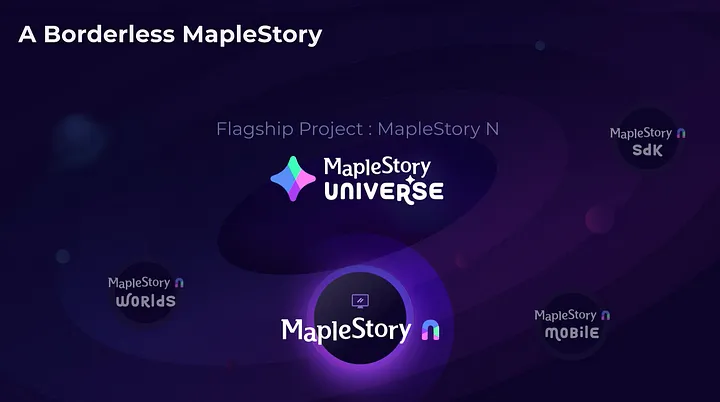
At last year’s GDC, our Executive Producer Sunyoung Hwang introduced MapleStory Universe, and some of you might have attended that session. For those who aren’t acquainted, MapleStory Universe is a virtual world where various games, applications, NFT items, and characters interact through blockchain protocol with Nexon’s MapleStory IP. Today, I want to focus on the development process of MapleStory N, our flagship PC MMORPG in MapleStory Universe. Specifically, I’ll elaborate on how we’ve infused real-world economic principles into the game system.
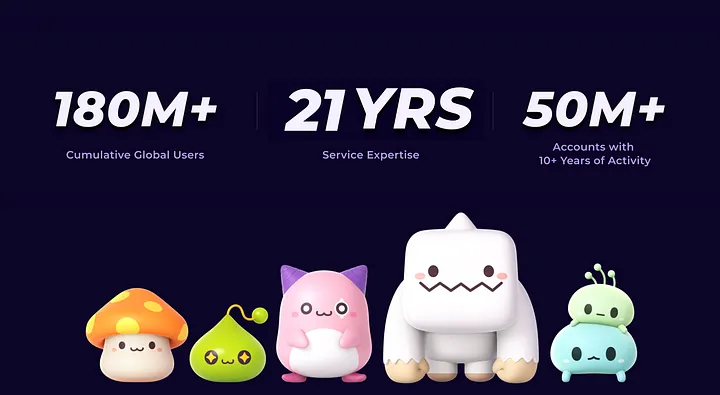
Let’s start by highlighting some statistics. MapleStory is an IP franchise that’s been loved over 21 years, boasting a user base of over 180 million. Among these users, more than 50 million accounts that have been actively playing MapleStory for more than 10 years. These are some of the MapleStory characters I have raised over the years. My journey with MapleStory began in 2003, just days after its official launch. I was 9 years old, in the third grade of elementary school, and like many Korean students then, I’d rush home after school to dive into MapleStory.
Bringing the Real World Economy to MMORPG
From a lifelong MapleStory fan who has spent tens of thousands of hours exploring the numerous characters, objectives, and continents, I became a developer who builds this vast virtual world. So, I have been giving a lot of thought to how the MapleStory IP, which I have enjoyed over the past 20 years, can continue to provide fun and sustainability for the next 20, 30 years or more. This was the starting point of the content I want to share with you today.

To understand the context, let’s do a quick recap on the evolution of games. Once, there was an era dominated by single-player games, which I thoroughly enjoyed as a child. Then came the widespread adoption of the internet, ushering in a new era of online multiplayer games. In a single-player game, it’s a solitary endeavor against the environment. The focus lies on hunting and looting items within a predetermined setting. A decent single player game offers around 50 to 100 hours of gameplay before confronting the final boss. In this single player game, no one really cares about the price of the item. All that matters is that you loot items, and get stronger along the way, getting prepared for the final boss battle.
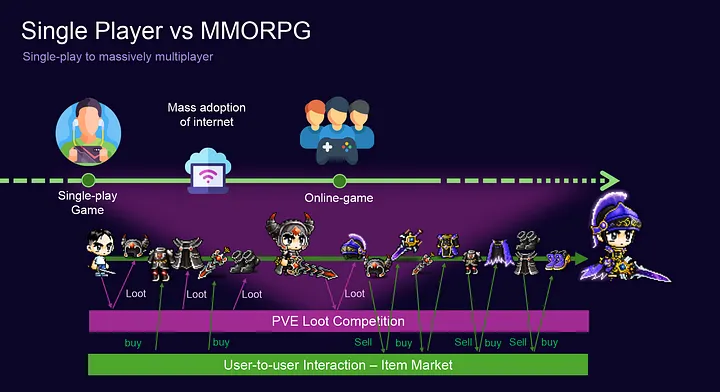
In MMORPGs, the story is quite different. It might appear similar, but fundamentally, you are in competition, competing for resources and rewards against other players. Shortly after starting a multiplayer game, you begin engaging and interacting with other users, essentially ‘transacting’ in a free-market environment. There are much more complex economic interactions among players, which were not present in single-player games. The market price of what you own becomes a critical factor. To be more precise, the factors that may influence the market price of your item are very important, such as how many items are currently available, how fast does this circulating supply increases, and the rarity of this item.
Most MMORPGs currently have a structure that infinitely generates items in proportion to the number of users and the amount of time they play. While this structure might work for single player games, it is not suitable for multiplayer games with market. In this structure where items are infinitely generated, maintaining the value of the user’s assets and keeping the reward experience (RX) high to create the core fun of the MMORPG is very challenging. Additionally, from the user’s perspective, this structure can feel very consumptive. If users learn through a vicious cycle where the value of the items they have worked hard to earn through time and effort continuously depreciates over time, the motivation to continue investing time and effort into the game decreases. This is similar to how most people in a country experiencing hyperinflation do not try hard to amass the inflating currency.
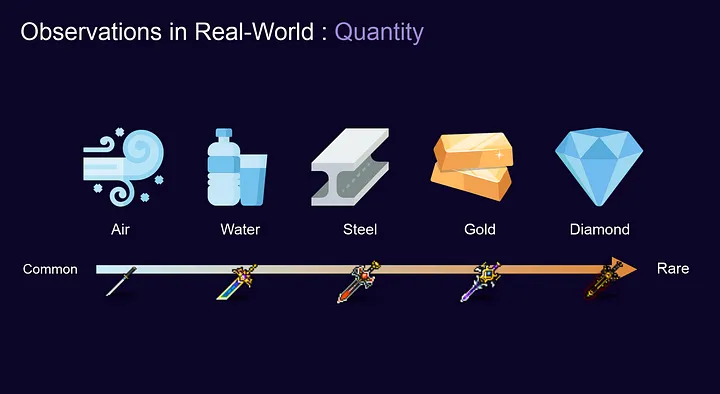
Now let’s take a look at the real world, and how resources exist. From air, which we don’t feel is rare at all, to water, and even diamonds, which we can perceive as very rare, there is a difference in the degree of rarity. But ultimately, everything is a resource that exists in limited quantity. I believed that game items should also exist in a finite number, just like in the real world, where their value is assessed based on scarcity and demand. That was about the infinite quantity of items that can lead to inflation and decrease the value of the user’s in-game assets.
Another issue arises with pricing. In free-to-play MMORPGs, there are numerous interactions between users and the development team, particularly through the premium cash shop, where essential (pay-to-win) game items are sold for cash. Considering the business model structure of free-to-play games, revenue is not generated directly from gameplay, so I don’t believe there’s inherently something wrong with selling items for cash.
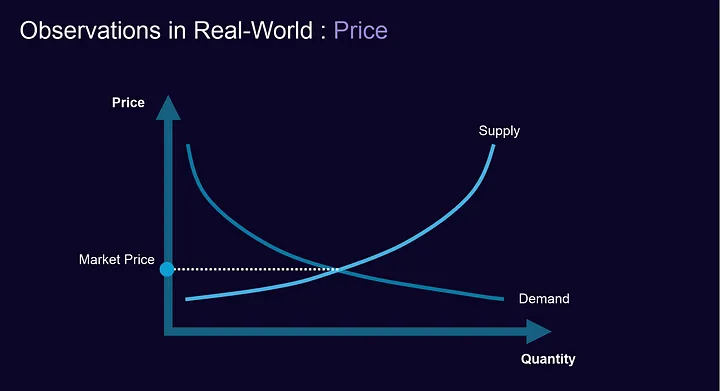
Let’s examine how price is set in the real world. As we all know, the market price is a compromise between the seller, who wants to sell as expensive as possible, and the buyer, who wants to buy as cheaply as possible. As explained earlier, at the moment, powerful items are sold for a fixed price, in infinite quantity, and also at less than their intrinsic value. If the items sold in the Cash Shop were to be priced at a “fair market price”, with prices changing based on gamer’s demand just like the real world economy, I believe that power inflation from cash shop sales would be dramatically reduced, and the value of items would remain stable for a much longer period of time, which would improve the sustainability of RX and ultimately the game.
So, on top of MapleStory MMORPG, which has been loved for over 20 years, we add these two new elements: 1) Supplying items in limited quantities like the real world and 2) Letting the demand of item drive its price. By applying these two simple elements, the game could be more: 1) economically immersive, 2) RX is enhanced, and 3) therefore more sustainable. We call this game MapleStory N.
Journey in Implementing Real-world Economy in MapleStory
Today, I’d like to share the behind-the-scenes process of applying the real world economy to MapleStory that I’ve outlined above. First, since some of you may not be familiar with MapleStory, let’s start with a quick overview of the various items that exist in MapleStory, after that, we’ll take a look at the limited quantity reward system and the demand driven pricing system.
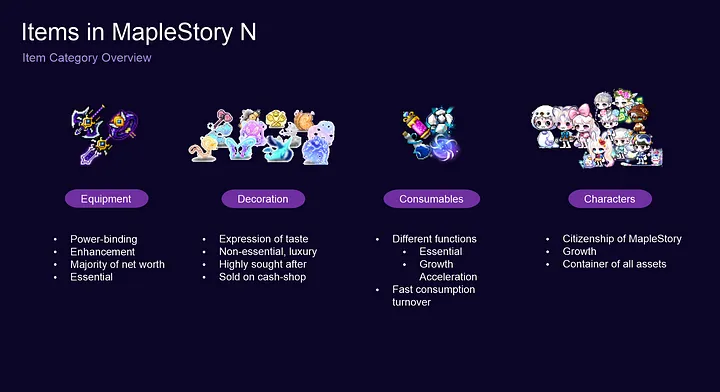
There are many different types of items that exist in MapleStory. But, for today’s presentation, we’ll confine the scope of discussion to equipment items, as they are essential in playing MapleStory. How strong you become in the game is proportionate to the equipment you possess, and enhancing the item is a significant aspect of playing MapleStory and the equipment items constitute for most of your total asset value.
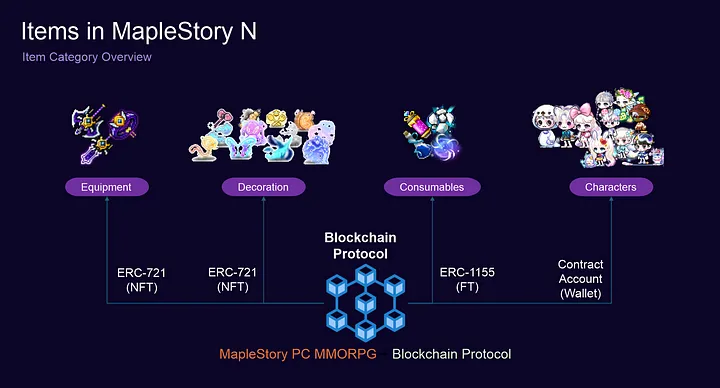
Now, let’s delve into today’s topic of supplying these essential items in finite quantity. Monitoring the quantity, issuance, and distribution of items becomes very important. Blockchain proves to be a valuable tool in making this process transparent and observable to all. Hence, all major assets in MapleStory Universe are managed by the blockchain protocol, allowing for free tradability. This is one of the reasons why we introduced blockchain technology and transformed MapleStory N into a blockchain MMORPG.
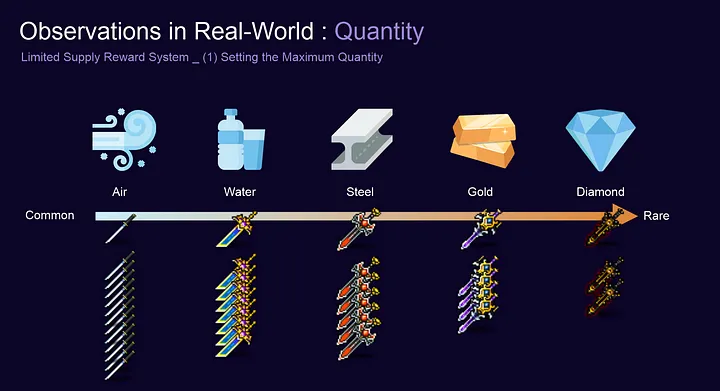
Returning to the slide we previously viewed, we must now determine the total quantity of each item. While there may not be a definitive answer, my team has undergone numerous cycles of assumptions and test iterations to finalize the numbers. Among the many factors considered, four main factors stand out. Let’s go through them one by one.
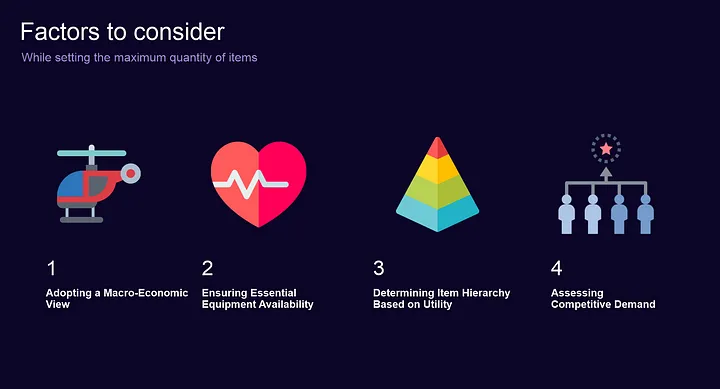
In order to determine the maximum quantity of items in MapleStory Universe, we need to take a macro-economic perspective. First, we must decide the peak number of users in our universe. This decision is challenging, and closer to the game’s launch, we’ll have more data to make an informed estimate. For today’s presentation, let’s use 400 users at peak, as that was the number in our most recent test. You can always scale it up when you have the final number.
The second factor is ensuring we have enough essential item parts for the expected number of players. MapleStory’s nature makes equipment items essential, and without them, sustainable play would be severely hampered. With our peak user estimation of 400 from the previous slide, let’s multiply it by the number of item parts each player needs to calculate the total number of items. For example, 1 x 400 player = 400 for a weapon because each player can only equip one weapon. We’ll repeat this process for every item category to determine the total quantity of items. By taking this approach, we aim to prevent players from experiencing the frustration of not being able to progress due to essential items like weapons being unavailable.
Now that we know how many weapon items are needed, let’s determine the quantity of weapon items per level group. We refer to MapleStory’s game design to set the distribution ratio for each level group based on the item’s utility duration. Short-term use items receive a lower distribution weight, while long-term use items receive a higher weight. This means that, for example, items that are expected to be used from level 10 to level 20, which is a fairly short period of time, will receive a lower distribution weight, while items that are used over a longer period of time, say, from level 50 to level 150, will receive a higher distribution weight.
Finally, we need to consider relative demand. For example, items like shurikens can only be used by the rogue class such as Night Lord and Night Walker, while weapons like two-handed swords are more universal. We expect higher demand and competition for universal items and adjust the weight accordingly.
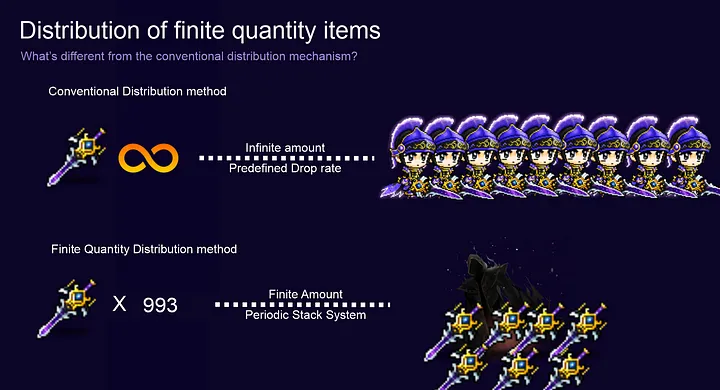
These are the steps we took to determine the maximum quantity of items for the most recent FGT (Focus Group Test) we had back in February. Now that we have already set the maximum quantities for the finite items, we have to revise how we should distribute these rewards. The conventional distribution method assumes infinite quantity of items, which doesn’t work with finite items. Therefore, we’ve decided to periodically distribute a set number of items to fields and boss monsters. For challenging boss monster like the ‘black mage’ items will be stacked every week, until someone defeats it for the first time. For the fields, the period distribution cycle is much faster than boss monsters. It’s set at every 20 minutes and the items will be distributed and stacked to various fields that exist in MapleStory. Gamers will be able to see this information openly, in real-time.
This system offers incentives for gamers to explore and engage with a broader range of contents and look for fields that is untouched by other users as there will be deliciously stacked items which the first one to spot it can scoop them easily. This Creates a whole new strategic and dynamic dimension of game play unlike the stagnant and static play patterns in status-quo MMORPGs.
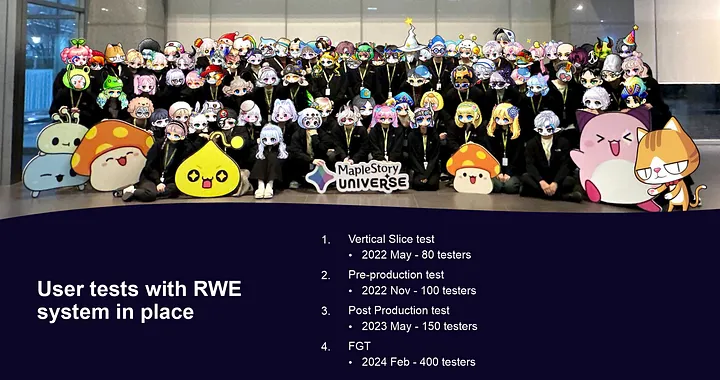
Now, with this system, we’ve conducted a number of tests, some internally and some with real gamers. Let’s review them. Over the past two-plus years of development, we’ve undergone several testing iterations. Initially, in 2022, we started with a vertical slice, or PoC, containing only a fraction of the features we just discussed. We’ve gradually increased the scope of coverage, and most recently, in February, we conducted an FGT with 400 testers on a build that was quite ready in terms of volume and depth.
Given our time constraints today, I won’t delve into every aspect of these tests. Instead, I’ll just share the highlights of the development and testing process, which I hope you’ll find insightful as you consider implementing limited quantities in your own games.
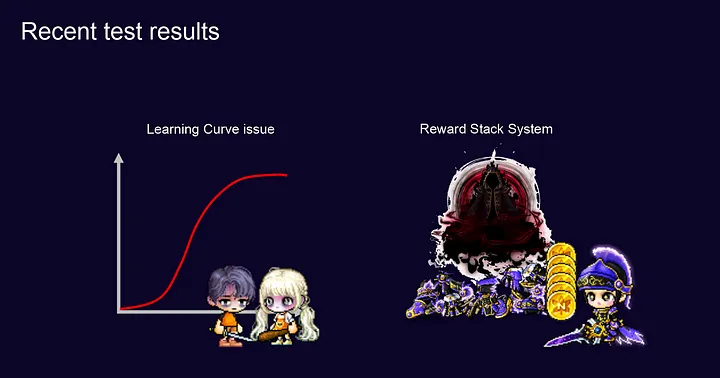
One notable issue was the learning curve. The system was unfamiliar to users accustomed to traditional MMORPGs based on infinite quantities. Some users had a hard time learning the mechanics of limited-quantity system and items being distributed dynamically across multiple fields. This is an issue we want to address. Conversely, users who quickly understood the system were delighted with the reward stack system. They found it enjoyable to strategically seek out fields with stacked rewards, just like treasure hunt. Additionally, being the first to defeat the boss monster that no one else had defeated, unlocking a large amount of rewards that had been accumulating for a long time.
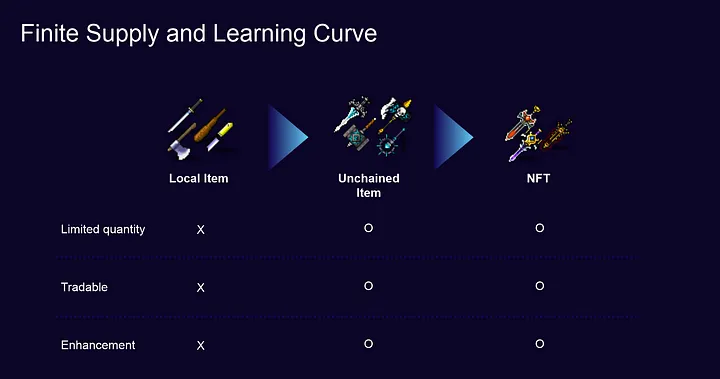
Coming back to the learning curve issue, it became evident that we needed to alleviate some early-game hurdles when players are still acclimating to the game. Specifically, thrusting gamers into direct competition from level 1 was not adequate learning curve design. Therefore, we implemented several buffer systems to let the user gradually ease in to the game.
The first and the most basic step is represented on the left, the ‘local items.’ These primarily consist of beginner’s equipment item. They are not quantity controlled and can be distributed to beginners just like the conventional system. But they are not tradable nor can be enhanced. Next is the ‘Unchained item’ in the middle. It serves as a bridge between the local item and the hard-to-get advanced NFT items. Unchained items are quantity controlled but exist in larger, more generously set quantities, resulting in less severe competition. Additionally, the abilities of unchained equipment grow along with the character’s level up to a certain point. So the item’s utility duration is much longer than that of other items. Unchained items remain highly useful for several weeks of gameplay and character growth. By this time, users will need to acquire the NFTs, which involves higher competition level. Indeed, setting the maximum quantity may act as a hurdle. You might also want to consider steps like the above to gradually ease-in the users with gentle learning curve design.
Demand-driven Pricing
Now, let’s talk about another crucial factor, ‘Pricing.’ When we look at how prices are measured in the real world, it’s evident that market prices arise from a compromise between sellers aiming to sell as high as possible and buyers seeking to purchase at the lowest possible cost.
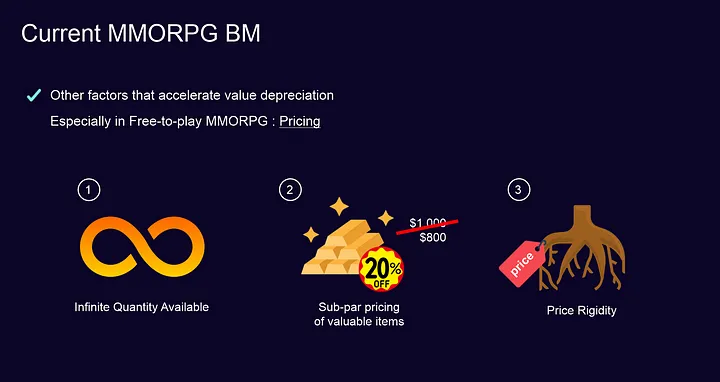
We previously talked about the issues associated with the status-quo method of selling in micro transaction cash shop, where each sale contributes to power inflation, gradually diminishing the value of existing items. This devaluation of asset poses a significant threat to the core fun of MMORPG, the RX, and the sustainability of the game.
One key area where this inflation is well-observed is from the item enhancements sold in the premium cash shop. In MapleStory N, we have removed the cash shop and there are no fiat money payment system. Instead, users are going to pay the in-game currency that they’ve earned to enhance the item. However, despite these changes, the pricing of these essential system remains critical.
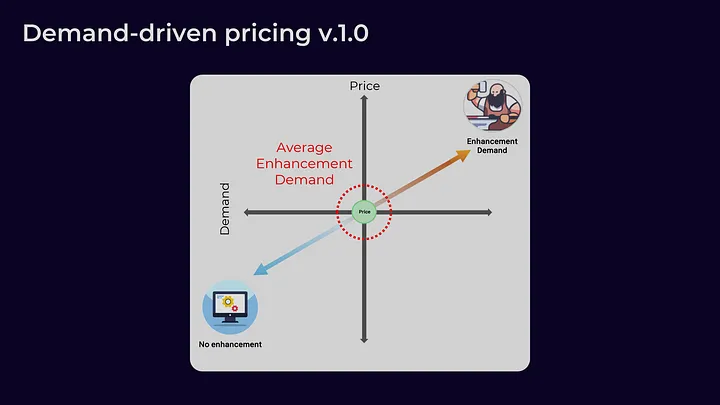
In essence, when users invest money to enhance items, we aim to adjust the enhancement price based on demand. If demand for enhancement is low, we want the price to decrease. Conversely, if many users are enhancing items, we want the price to increase. To be more precise, the price should fluctuate based on whether the demand for enhancement surpasses the weighted average of enhancement demand. By implementing this algorithm, price will adjust in real-time, driven by gamers’ demand, mirroring pricing mechanism in real-world economy.
To build this system, we needed to collect some data. So, we’ve first created a step called ‘Price discovery step’. During the price discovery step, which happens over 7 days since the very first enhancement on an item, we try to collect three pieces of data. 1) Starting Price, 2) Average Enhancement Price, and 3) Average Demand, which is measured by average demand per hour. With this data, we can eventually build the demand-driven pricing model outlined in the previous slide.
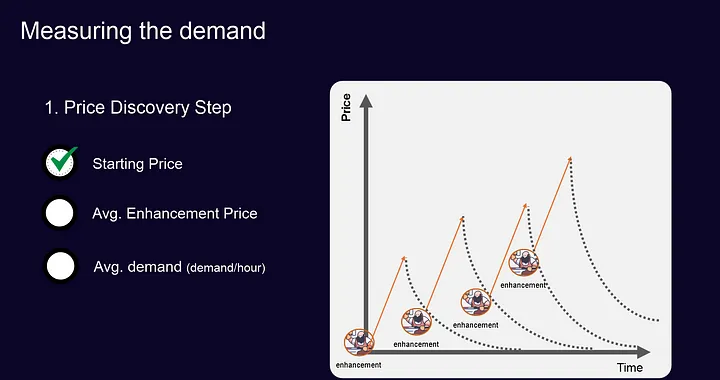
Let’s first take a look at the starting price. Where should the price start? Especially for the first ever enhancement demand? We’ve experimented different numbers, trying to find the golden number. After enough iterations, we realized that only ZERO is the right price, especially when our original intent is to let demand drive the price. From zero, if someone enhances the item, the price will jump high, and it will immediately start to drop, about 5% every minute until someone presses the enhance button. At the same time, we collect all the price points at which the enhancement was purchased, and we calculate the average. By the way this discovery step ends if 30 enhancements are done, or 7 days later, whichever comes first. Simultaneously, we also look at the purchase points and calculate the average demand per hour.
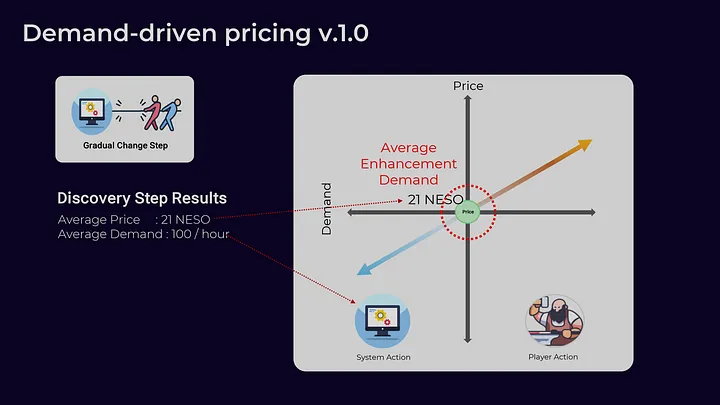
We use the data we collected from the previous step to build the algorithm for gradual change step that we initially saw.
We have conducted multiple tests for this demand-driven pricing, and we received plenty of positive feedbacks on it. To share some of them, our testers said that a new level of strategy is required, as enhancement prices are constantly changing based on the demand, and this demand is not just individual. You have to be good at reading the demand of other players as well. They said it almost felt like they were in a live auction bidding for enhancement. This has led them to think about a variety of strategies, such as whether they should spend money now to enhance an item to move up the ladder faster, or wait until the enhancement price falls, or look for alternative items with a low enhancement demand, which they can practically enhance for free.
Another feedback was that the conventional enhancements were very static and didn’t have much element of fun, except for when you are lucky and get a great option out of it. But with demand-driven pricing, seeing the prices change in real-time made it feel like your actions were interacting with the game and impacting it, and it was novel and fun. Although you are enhancing an item alone, but it feels like you are doing it together with a bunch of other players.

Another interesting finding in our most recent FGT was that some users would purchase numerous inexpensive items to enhance, then upgrade them to the Legendary level and sell them on the marketplace for a decent profit. This user was able to achieve a very high ranking in our FGT, where the ranking was primarily based on the amount of Neso the gamer had. While it was quite fun to watch diverse strategies being developed, I also realized the importance of removing asymmetric information and making sure every gamer understands how and why the price changes.
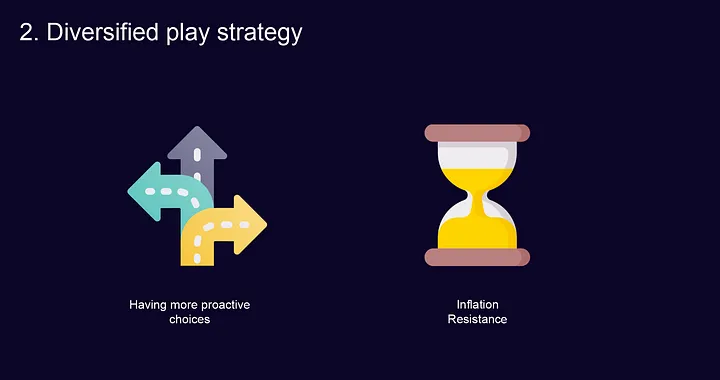
We also noticed that some of the most popular item’s enhancement prices were very high, and many of the users decided to go for alternatives to that popular item, which was quite hard to observe in the conventional MapleStory. Demand-driven pricing has also diversified user’s choice of which item to go for depending on the current market price of the enhancement. They would rather go for an unpopular item, and as the item’s enhancement price would be very inexpensive, they can cheaply enhance the item until it has great options, often better than the average option of popular items. Additionally, we also found out that limited item quantity coupled with demand-driven pricing makes the item’s market price much more stable over long term. Of course, we have yet to try it out in live service environment and also with more long-term tests.
More Immersive, More realistic MMORPG
We are nearing the end of presentation, and I hope you now grasp the significance of today’s session title: “Bringing the Real World Economy to MMORPG.” What I’ve shared today applies not only to MapleStory but also to many other MMORPGs with a complex economic system. By aligning some of the key economic elements in your game those of the real world economy, your game can be more immersive, without having to upgrade other elements of game like ‘graphics’ and such will make your game more fun and sustainable.
If you are interested in our project MapleStory Universe, please subscribe our twitter and medium, where we’ll be sharing more information about the project’s progress. Thank you everyone. Have a great day and I hope to see you again in next year’s GDC!